
If your device is connected, FDA cybersecurity review is likely part of your filing. Since March 29, 2023, cyber device rules under FD&C Act §524B apply to many 510(k), De Novo, PMA, PDP, and HDE submissions, and since October 1, 2023, missing cybersecurity content can block acceptance.
Here’s the short version:
- A device is often in scope if it has sponsor-approved software, direct or indirect internet access, and tech open to cyber threats.
- FDA expects proof, not claims: threat modeling, security risk records, testing results, SBOM, architecture details, and a postmarket plan.
- This is a patient safety issue: cyber failures can affect readings, therapy, uptime, and care delivery.
- Postmarket work matters too: manufacturers need monitoring, patching, and disclosure steps; HDOs need inventory, patch tracking, and response plans.
- Weak documentation can cost time and money through review delays, rework, field actions, recalls, and public enforcement.
A few facts stand out. The article points to FDA action such as the July 2023 Class II recall tied to Illumina and the January 2025 safety communication on Contec CMS8000 / Epsimed MN-120. That tells me FDA treats cybersecurity as part of the device safety case, not as a side issue for IT.
If I boil the full piece down to one point, it’s this: you need the right cybersecurity records before submission, and you need a clear process after clearance.
Which Medical Devices Fall Under FDA Cybersecurity Requirements
How to Tell If a Product Qualifies as a Cyber Device
Under Section 524B, a device counts as a cyber device only when it meets all three parts of the legal definition: it includes software validated, installed, or authorized by the sponsor as a device or in a device; it has direct or indirect internet access; and it contains technology that could be open to cyber threats.[10][20][21][23] That definition matters because it decides when cybersecurity evidence becomes mandatory during premarket review.
FDA uses a broad view of software. It includes firmware and programmable logic.[1][5] The agency also treats any direct or indirect internet connection as enough. That can mean a wireless or wired connection, a companion app, a cloud link, or access through a hospital network.[22][8]
Some stand-alone devices may sit outside §524B. Even so, that doesn't mean cybersecurity can be ignored. FDA may still expect cybersecurity documentation during review, even when the device does not fall within §524B.[2][15][16]
For devices outside §524B that still use software, firmware, or programmable logic, FDA still expects secure design controls, a security risk file, and risk-based vulnerability monitoring.[16][19][18] The reason is pretty simple: device vulnerabilities can create direct patient-safety problems.
Which Submission Pathways Require Cybersecurity Review
Once a device qualifies, the next step is figuring out which submission pathway triggers review. The device definition shapes the documentation burden. For §524B devices, FDA expects a full package that covers:
- security risk management
- threat modeling
- SBOM
- vulnerability handling
- secure development evidence
- a postmarket plan[15][16][12][17]
For other devices with software, FDA still strongly expects these same materials in practice.[15][16][12][17]
Section 524B duties apply across 510(k), De Novo, PMA, PDP, and HDE submissions whenever the device meets the cyber device definition.[15][16][12] De Novo applications and PMAs usually get the deepest cybersecurity review. In some cases, that leads to special controls language tied to cybersecurity requirements. Traditional 510(k)s also carry risk: if key cybersecurity documentation is missing, the submission can face RTA rejection.[9][16][17]
Cybersecurity review doesn't stop with first-time submissions. If a supplement adds a software update or a new connectivity feature, the cybersecurity impact must also be addressed.
Manufacturers are responsible for premarket evidence and remediation, while HDOs are responsible for secure deployment and operations.[3][7][12]
sbb-itb-535baee
What a Compliant FDA Submission Must Include
Required Cybersecurity Evidence in Premarket Submissions
Once a device falls in scope, FDA wants proof that cybersecurity controls are built into the product itself. A compliant premarket submission needs traceable cybersecurity evidence tied to design controls and QMS records.[12][4] FDA reviews these records to check that the device is secure by design and that any remaining risk is under control.
At the center of the submission are secure architecture diagrams. These should show data flows, trust boundaries, network interfaces, and security zones. Pair those diagrams with a threat model and cybersecurity risk assessment that identifies threats, ranks them by clinical impact, and maps each threat to a control. Authentication and authorization records should spell out user roles, access rights, and supported sign-in methods, along with controls that prevent default or shared credentials.[12][15]
Encryption records should state which algorithms and key lengths are used, how keys are generated, stored, and rotated, and whether hardware security modules are part of the setup. Logging records should explain which events are captured, how logs are protected and retained, and how they can be exported to SIEM tools.[12][4]
Testing evidence matters just as much. FDA expects results from SAST, DAST, fuzzing, penetration testing, and vulnerability scanning, with the scope, methods, findings, severity, and either remediation details or accepted residual risk clearly documented.[12][4] A machine-readable SBOM in SPDX or CycloneDX format should list all commercial, open-source, and off-the-shelf components, including component name, version, supplier, support status, and end-of-support date.[5][2][25][4] FDA also expects a postmarket cybersecurity plan that covers monitoring, coordinated vulnerability disclosure, and patching.[7][4]
This material should connect back to the Secure Product Development Framework (SPDF) and the quality management system (QMS). It should not be stitched together just for the submission.[24][4][26]
Submission Timing and Documentation Checkpoints
Finish these artifacts before submission, and update them whenever the design, software, or threat model changes. In plain English: have the paperwork done before you file. Use the table below as a checklist.
| Artifact | Primary Purpose in FDA Review | Key Internal Stakeholders |
|---|---|---|
| Secure architecture and data flow diagrams | Demonstrate secure-by-design architecture, network segmentation, trust boundaries, and data protection paths | Systems engineering, security architects, regulatory affairs |
| Threat model and risk assessment report | Show systematic identification, evaluation, and mitigation of cybersecurity threats and their clinical impact | Risk management, clinical engineering, security teams |
| Authentication/authorization design specification | Document how user roles, access rights, and identity controls prevent unauthorized access | Software engineering, IT/security, clinical stakeholders |
| Encryption and key management design | Explain how data-at-rest and data-in-transit are protected, including algorithms and key handling | Software/hardware engineering, security teams |
| Logging and monitoring specification | Demonstrate that the device supports detection and investigation of cybersecurity events | Security operations, biomedical engineering, IT |
| Cybersecurity testing reports (SAST/DAST, fuzzing, penetration tests) | Provide evidence that controls have been verified and vulnerabilities identified and addressed | QA, security testing teams, regulatory affairs |
| Machine-readable SBOM | Identify all software components, versions, suppliers, support status, and end-of-support dates | Product security, software engineering, regulatory affairs |
| Postmarket cybersecurity monitoring and response plan | Show the required postmarket cybersecurity plan | Product security, service operations, regulatory affairs |
These same controls then serve as the baseline for postmarket monitoring and response.
Postmarket Risk Management, Timelines, and Enforcement
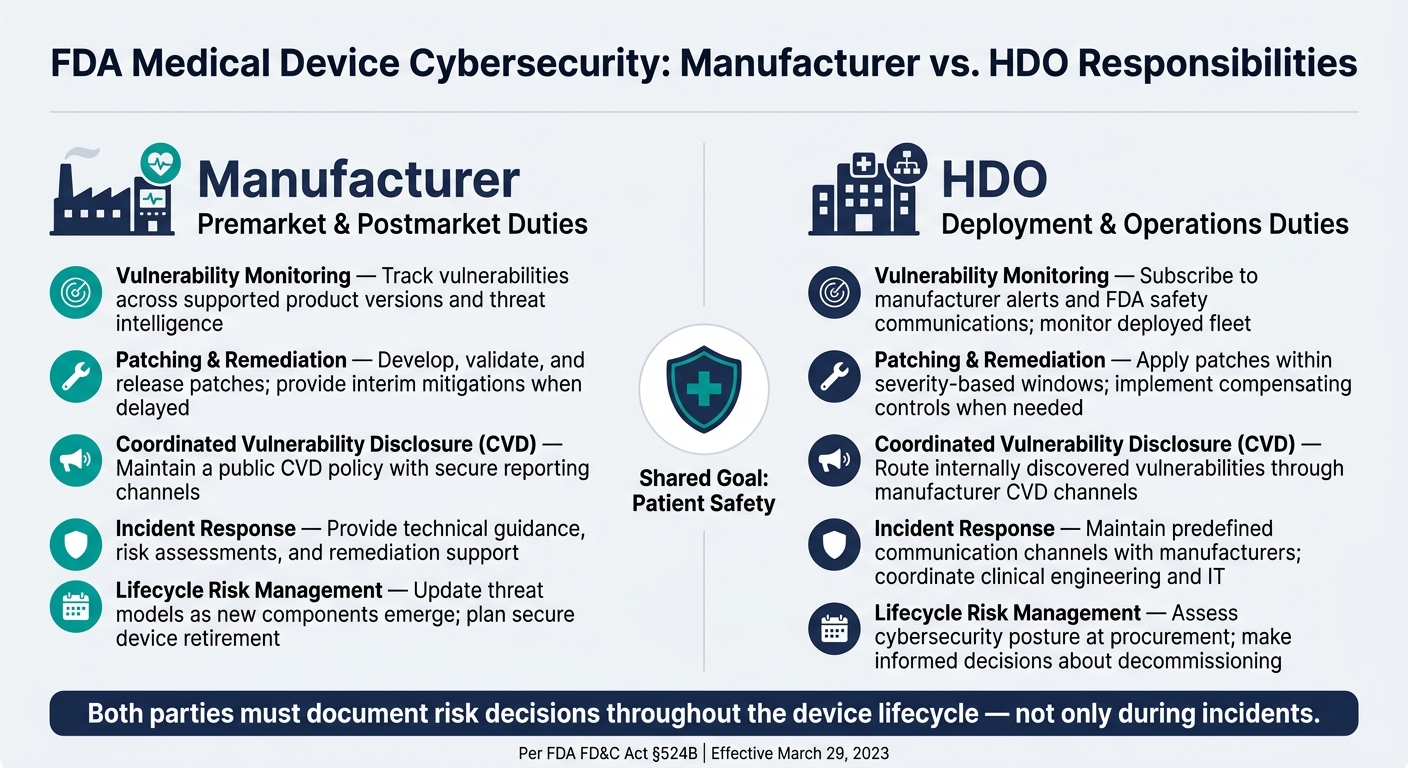
FDA Medical Device Cybersecurity: Manufacturer vs. HDO Responsibilities
Postmarket Responsibilities for Manufacturers and HDOs
After clearance, cybersecurity work doesn't stop. It shifts from premarket review to day-to-day responsibility.
Once a cyber device is in use, Section 524B of the FD&C Act requires manufacturers to keep a formal postmarket cybersecurity plan in place. That plan needs to cover continuous monitoring, vulnerability assessment, patch development and deployment, and coordinated vulnerability disclosure (CVD). Manufacturers can use tools like Censinet Connect™ Copilot to automate responses to security questionnaires and assessments.[2][6] FDA's postmarket guidance pushes a risk-based approach: known unacceptable vulnerabilities should be handled on a regular risk-based cycle, while critical vulnerabilities need out-of-cycle action and immediate remediation, with interim mitigations used until patching is finished.[32]
HDOs also have work to do. They need an up-to-date inventory of connected devices, including location, firmware, and configuration. Before buying devices, they should also ask for SBOMs, patch commitments, and vulnerability disclosure procedures.[3][2]
The table below separates manufacturer and HDO duties.
| Responsibility Area | Manufacturer | HDO |
|---|---|---|
| Vulnerability monitoring | Track vulnerabilities across supported product versions and relevant threat intelligence | Subscribe to manufacturer alerts and FDA safety communications; monitor the deployed device fleet |
| Patching and remediation | Develop, validate, and release patches; provide interim mitigations when patches are delayed | Apply patches within severity-based windows; implement compensating controls when patching is not immediately possible |
| Coordinated vulnerability disclosure | Maintain a publicly documented CVD policy with secure reporting channels and defined response timelines | Route internally discovered vulnerabilities through manufacturer CVD channels and align internal advisories with manufacturer notices |
| Incident response coordination | Provide technical guidance, risk assessments, and remediation support | Maintain predefined communication channels with manufacturers and coordinate clinical engineering, IT security, and risk management teams |
| Lifecycle risk management | Update threat models and risk analyses as new components or integrations emerge; plan for secure device retirement | Assess cybersecurity posture at procurement and make informed decisions about continued use or decommissioning when manufacturer support ends |
Both sides should document how they make decisions throughout the device lifecycle, not only during incidents. That paper trail matters. If FDA reviews the record, clear documentation helps show a systematic and reasonable approach to managing risk.[13][11][14]
Common Delays, Enforcement Actions, and Business Impact
Weak or missing cybersecurity information can slow FDA review fast. It can lead to acceptance issues or deficiency findings, which extend the review cycle while sponsors pull together more data and resubmit materials.[2][27][9] That delay often turns into extra engineering hours, more testing, documentation rework, and lost time to revenue.[27][28][29]
And when postmarket duties break down, FDA can move in public ways. The agency has issued safety communications when vulnerabilities created a credible patient safety risk. In January 2025, FDA issued a safety communication for Contec CMS8000 and relabeled Epsimed MN-120 patient monitors, stating the devices could be remotely controlled by an unauthorized user, included a backdoor, and could exfiltrate PII and PHI after internet connection.[31] In July 2023, FDA determined that Illumina's cybersecurity vulnerability response for its sequencing instruments constituted a Class II recall because the vulnerability could cause serious adverse health consequences.[30]
Those examples make the point pretty clearly: FDA sees cybersecurity as a patient safety matter, not just an IT problem. If risks aren't controlled well enough, the agency may step in with public action.
The table below maps common noncompliance scenarios to likely consequences.
| Noncompliance Scenario | Likely Consequence |
|---|---|
| Critical vulnerability patched months after discovery | Increased enforcement risk; significant remediation cost |
| Incomplete or missing SBOM in premarket submission | RTA decision or deficiency letter; delayed clearance |
| No documented postmarket cybersecurity plan | Inspection finding; CAPA required; potential enforcement action |
| No device inventory at HDO | Slow incident response; inability to identify affected devices; greater patient safety risk and regulatory scrutiny |
| Inadequate CVD program | Vulnerability disclosure gaps; reputational damage; potential FDA criticism in safety communications |
| Serious exploitable vulnerability with no interim mitigation | FDA safety communication; possible field action or recall; emergency engineering costs |
How to Build Repeatable Compliance Processes Across a Device Portfolio
Building Repeatable Workflows for Evidence, Monitoring, and Response
Once your compliance requirements are clear, the next step is making them repeatable across every device and every update. The big idea is simple: cybersecurity should live inside your QMS, not sit off to the side as its own process.
That means folding it into design control, change control, and document control so each update produces the same kind of audit-ready evidence. In practice, that looks like using standard security requirements in design inputs, requiring a security impact analysis for every software or configuration change, and setting rules for how medical device security risks, SBOMs, and vulnerability management plans are versioned and retired.
It also helps to use a cross-functional cybersecurity committee for key decisions. A documented RACI matrix can keep ownership clear across teams for:
- Threat modeling
- Vulnerability disclosure
- Field corrective actions
- Procurement evaluations
For monitoring and response, use one intake queue for vendor notices, FDA alerts, vulnerability feeds, and internal reports. Then triage each item based on exploitability and patient impact. From there, severity-based playbooks with fixed timelines and escalation paths help teams act the same way every time, instead of making it up as they go.
Using Censinet RiskOps™ to Support Medical Device Risk Management
At portfolio scale, the challenge moves from policy to execution. The hard part is keeping evidence, assessments, and remediation in one place. A central record makes that easier by helping teams keep SBOMs current, track vendor responses, and maintain risk visibility across the portfolio.
Censinet RiskOps™ gives healthcare organizations a platform for structured, repeatable risk operations work. HDOs can use standardized assessment questionnaires for medical devices and supporting vendors, store evidence such as SBOMs and security white papers in a central repository, and keep portfolio-level risk views that support postmarket risk management. Critical findings are sent to the right owners - security, procurement, and clinical engineering - and tracked to closure.
Censinet AI™ can speed up some of the most time-consuming work. It can draft questionnaire responses from prior assessments, flag possible control gaps in vendor evidence, help draft vulnerability disclosure notices, and route high-priority issues to designated reviewers. Humans still keep final approval. Risk teams set the rules and retain final approval, so automation supports governance rather than replacing it.
| FDA Expectation | Internal Workflow Step | Censinet-Supported Process |
|---|---|---|
| Threat modeling and risk analysis | Include cybersecurity risk analysis in design reviews and procurement intake | Standardized risk questionnaires; portfolio risk scoring in RiskOps™ |
| SBOM maintenance and vulnerability tracking | Maintain device SBOMs and run regular vulnerability checks | Central evidence repository; automated vulnerability flagging |
| Secure update and patch management | Patch evaluation, testing, and deployment scheduling across sites | Workflow routing to clinical engineering; remediation tracking |
These workflows help keep evidence, monitoring, and remediation aligned across the portfolio.
Conclusion: Key FDA Cybersecurity Compliance Points to Remember
The FDA cybersecurity checklist boils down to four things: scope, premarket proof, postmarket follow-through, and steady governance.
Start with scope. You need to confirm whether your product meets the definition of a cyber device under Section 524B of the FD&C Act. In plain English, that means a connected medical device with sponsor-authorized software, firmware, or programmable logic. This step comes first because FDA reads connectivity broadly.[11][22][4][37]
From there, premarket submissions need the full set of required cybersecurity materials: system architecture, threat modeling, SBOMs, test results, patching plans, and a postmarket process. If that proof is missing, review can stall. Since October 2023, FDA has refused submissions that do not include the required cybersecurity documentation.[1][35]
Once a device is cleared, the job changes. The question is no longer just whether the device was secure at submission. It becomes whether security is being maintained over time. Manufacturers need to monitor, fix issues, and notify the right parties. HDOs need to review advisories, apply mitigations, and document their risk decisions.[13][3][33] That only works when manufacturers and HDOs stay in sync.
The stakes are not small. Incomplete submissions can slow review, and postmarket gaps can move up the enforcement ladder, including Form 483 observations, warning letters, recalls, and consent decrees.[34][29] Warning letters are public records, which means they can affect reputation, market access, and investor confidence.[29][34][36]
At the portfolio level, repeatable compliance depends on doing this the same way every time. That means building cybersecurity into quality processes and keeping a portfolio-level risk register in a platform like Censinet RiskOps™. The goal is simple: manage cybersecurity as an auditable program with one process, one record, and one owner for each risk.
